By TapWater.uk Research··Based on official DWI data
Short answer
Yes, UK tap water is among the safest in the world. The Drinking Water Inspectorate tests it against 40+ parameters and it passes 99.96% of compliance checks. But "safe" does not mean "perfect" — trace contaminants, hard water, and ageing pipes mean your specific postcode matters. Read on to understand exactly what is in your water.
How UK tap water is regulated
In England and Wales, drinking water is overseen by the Drinking Water Inspectorate (DWI) — an independent body that scrutinises the performance of the 22 licensed water companies. Scotland has its own regulator, Drinking Water Quality Regulator for Scotland (DWQR), and Northern Ireland is covered by the Drinking Water Inspectorate for Northern Ireland.
The legal standards are set by the Water Supply (Water Quality) Regulations 2016, which establish maximum permitted concentrations for more than 40 parameters — from bacteria and heavy metals to pesticides and nitrates. These limits are derived from World Health Organization guidelines and, where relevant, former EU standards. Water companies are legally required to test water at treatment works, throughout the distribution network, and at customers' taps.
The result is a system that catches problems early. In 2023, UK tap water passed 99.96% of all compliance tests — a figure that has remained consistently above 99.9% for two decades. When failures occur, they are typically short-lived and result in public notices from water companies.
Parameters tested
40+
Bacteria, metals, chemicals
Compliance rate
99.96%
Tests passed in 2023
Regulatory standard
WHO
Guidelines-based limits
What is actually in your tap water?
Tap water is not just H₂O. By the time it reaches your glass, it contains a range of substances — some deliberately added, some naturally present, and some that arrive as unwanted passengers. Here is what each one means for you.
Chlorine
Chlorine is added at treatment works to kill bacteria and viruses. It is the reason your tap water is safe to drink straight from the tap without boiling. At the low concentrations used in UK water (typically 0.1–0.5 mg/L), it poses no health risk. The main downside is taste — chlorine gives tap water a slight swimming-pool smell that many people find off-putting, particularly in some parts of London and the South East. Leaving water in an open jug in the fridge for a few hours removes most of it.
Lead
Lead enters drinking water not from treatment works but from old pipes — specifically the lead service pipes that connected homes to the mains supply before about 1970, and older internal plumbing. The legal limit in the UK is 10 micrograms per litre (µg/L), which aligns with WHO guidance. The critical point is that there is no known safe level of lead exposure, particularly for children and pregnant women. If your home was built before 1970, it may still have lead pipes. Running the cold tap for 30 seconds before drinking flushes stagnant water from the pipes and is the simplest precaution. See our full guide to lead pipes in UK homes.
Nitrates
Nitrates come primarily from agricultural fertilisers leaching into groundwater and rivers. The UK legal limit is 50 mg/L, which matches EU and WHO standards. At levels below the limit, nitrates are generally harmless for adults. The main concern is infants under six months — high nitrate levels can interfere with oxygen transport in blood, causing a condition called methaemoglobinaemia. Areas of intensive farming in East Anglia and parts of the Midlands tend to have the highest nitrate readings. Check your postcode's nitrate levels on TapWater.uk.
PFAS ("forever chemicals")
PFAS — per- and polyfluoroalkyl substances — are synthetic compounds that do not break down in the environment or the human body. They have been detected in source waters near military airfields, airports, and industrial sites across the UK. Unlike the EU, which introduced a legal limit of 0.1 µg/L for PFAS in drinking water in January 2026, the UK currently has no statutory limit. This is the most significant unresolved gap in UK water regulation. Read our full PFAS guide for detail on health effects and how to filter them.
Fluoride
About 10% of UK homes receive fluoridated water, mainly in parts of the West Midlands, North East England, and East Midlands. Fluoridation was introduced as a public health measure to reduce tooth decay in children. The legal limit is 1.5 mg/L. Natural fluoride occurs in some groundwater at varying levels. Most of the UK — including Scotland, Wales, and most of Northern Ireland — has naturally low fluoride concentrations. See our fluoride data by area.
Hardness minerals (calcium and magnesium)
Water hardness is caused by dissolved calcium and magnesium — minerals that occur naturally as water passes through limestone and chalk. Hard water is not a health risk; in fact, the minerals it contains contribute to your daily calcium and magnesium intake. The main downsides are practical: limescale on kettles and shower heads, and a slight chalky taste. The UK water hardness map shows the stark divide between the hard South East (where water filters through chalk aquifers) and the soft North and West (where it runs off granite moorland).
How water quality varies across the UK
"UK tap water" is not a single thing. Water quality varies significantly by region, water company, and even by individual postcode. The differences are driven by geology (what the water passes through in the ground), catchment type (upland reservoirs vs lowland rivers), and the age and condition of local pipe networks.
London draws much of its water from the River Thames and River Lee — lowland rivers that pick up agricultural runoff from a large catchment area before treatment. The water is hard (250–350 mg/L CaCO₃), reliably safe, and occasionally tastes of chlorine. Trihalomethane levels (a by-product of chlorinating organic-rich river water) can be higher than in upland areas.
Scotland generally has some of the softest and cleanest water in the UK, sourced largely from upland lochs and reservoirs in areas with minimal industrial or agricultural footprint. Scottish Water consistently scores well in DWI-equivalent assessments.
Parts of East Anglia and the East Midlands tend to have higher nitrate readings due to intensive arable farming. Areas near former industrial sites or military airfields are more likely to show PFAS detections in source water monitoring. Northern and Western regions — Cornwall, Wales, the Lake District — tend to have the softest water and lowest mineral levels overall.
Regional averages only tell part of the story. Postcode-level data is more useful — because two postcodes five miles apart can be served by different treatment works with meaningfully different profiles. That is why TapWater.uk reports at postcode district level. You can compare postcodes side by side to see the differences directly.
Tap water vs bottled water: which is actually better?
The widespread belief that bottled water is purer than tap water does not hold up to scrutiny. Both are regulated to strict standards in the UK, but the testing regimes differ significantly. Water companies test tap water thousands of times a year — at source, at treatment works, in the distribution network, and at the tap. Bottled water is tested far less frequently, often only at the source spring, and can sit in plastic bottles for months before reaching you.
The environmental and financial costs of bottled water are stark. A litre of UK tap water costs approximately 0.1p — a fraction of a penny. A litre of bottled water costs 50–150p. Over a year, a household drinking bottled water exclusively instead of tap water would spend somewhere between £600 and £1,800 extra, for no measurable safety benefit. Plastic production for bottled water generates roughly 500 times more environmental impact per litre than tap water.
In most UK homes, yes — bathroom cold tap water is safe to drink. Modern properties built since the 1970s are typically plumbed so that all cold taps draw directly from the mains supply. The water quality is the same as the kitchen tap.
The exception is older properties — particularly pre-1970s houses — that use a "vented" plumbing system where a cold water storage tank (header tank) in the loft feeds bathroom taps. This tank stores mains water and distributes it to the bathroom cold tap and hot water cylinder. The water in a header tank is not continuously refreshed, can accumulate sediment or dust, and is technically not drinking water standard once it leaves the mains supply.
A simple test: if your bathroom cold tap runs noticeably colder in winter (tank water) or has lower pressure than the kitchen tap, you likely have a header tank system. In these homes, the kitchen tap — which almost always runs directly from the rising main — is the right choice for drinking water.
When should you be more careful?
For the vast majority of people in the UK, tap water from a modern home is safe to drink without any additional precautions. There are, however, specific situations where extra care is warranted.
Pre-1970 homes. If your property was built before about 1970, it may have lead service pipes connecting it to the mains, or lead solder on internal copper pipes. Lead leaches into water that sits in pipes overnight. Running the cold tap for 30 seconds each morning is good practice, and if you have young children or are pregnant, it is worth contacting your water company to ask about pipe replacement. Read our lead pipes guide for more detail.
Private water supplies. Around 1% of the UK population uses a private water supply — a borehole, spring, or private well — rather than a mains connection. These are not regulated by water companies and do not benefit from the same continuous treatment and testing regime. If you are on a private supply, you should test your water independently at least once a year and after any nearby agricultural or construction activity.
Immunocompromised individuals. People undergoing chemotherapy, those with HIV/AIDS, or others with severely compromised immune systems may be advised by their doctor to take extra precautions — such as boiling water or using a certified filter — because even the low levels of microorganisms present in compliant tap water can pose a risk.
Infant formula preparation. Tap water is safe for making up infant formula, but the NHS recommends using freshly boiled water that has cooled to at least 70°C to kill any residual bacteria in the formula powder itself, not in the water. In areas with high nitrate levels, some health authorities advise using low-nitrate bottled water for infants under six months.
What you can do right now
The most useful thing you can do is understand what is actually in your water — not regional averages, but the specific profile for your postcode. TapWater.uk pulls data from the Environment Agency, the DWI, and water company reports to give you a postcode-level picture of contaminants, hardness, and quality scores.
Check your postcode
See your water quality score, hardness, and any flagged contaminants.
Beyond checking your data, here are the practical steps worth taking:
Run the cold tap for 30 seconds in the morning before drinking, especially in older homes. This flushes any water that has been sitting in the pipes overnight and may have picked up lead or copper.
Consider a filter if your data flags concerns. An activated carbon filter addresses chlorine taste and some contaminants. A reverse osmosis system is more thorough, removing 90–99% of PFAS, lead, nitrates, and other compounds. See our filter recommendations for what works for which contaminants.
Contact your water company about lead pipes. Many companies offer free lead pipe replacement from the boundary of your property to the mains. This is one of the most impactful improvements you can make if your home was built before 1970.
Switch from bottled to filtered tap water. If you drink bottled water regularly for taste reasons, a filter jug or under-sink filter will give you better-tasting water at a fraction of the cost and plastic footprint.
If you want better water than the tap gives you
UK tap water is safe, so none of these is a must. They are the three fixes our readers pick most: a jug that takes out chlorine taste and more, a shower filter, and a reverse osmosis unit that needs no plumbing.
The jug for cleaner drinking water
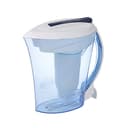
ZeroWater 12-Cup Ready-Pour
Jug Filter · NSF/ANSI 53, NSF/ANSI 401
Why it fits
NSF-certified to remove PFAS and heavy metals
Includes TDS meter so you can verify performance
5-stage filtration in a simple jug format
Trade-offs
Filters last only 2–3 weeks in hard water areas
Slower pour rate than BRITA — takes 5+ minutes to fill
Data on UK tap water quality is drawn from the Drinking Water Inspectorate's annual reports, the Environment Agency's Water Quality Archive, and water company Water Quality Reports published under statutory obligations. The 99.96% compliance figure is from the DWI's 2023 Drinking Water in England report. Regulatory standards are sourced from the Water Supply (Water Quality) Regulations 2016 (SI 2016/614) and the WHO Guidelines for Drinking-water Quality (4th edition, 2022).