Based on Environment Agency monitoring data. Last updated 22 April 2026.
According to TapWater.uk's analysis, 19 PFAS compounds have been detected across 12 sampling points in Birmingham. The highest recorded level is 0.025 µg/L (6:2 FTSA).
Compounds detected
19
Sampling points
12
Highest level
0.025 µg/L
Latest date
22 April 2026
<0.01 µg/L
0.01–0.075 µg/L
>0.075 µg/L
PFAS levels over time
Monthly aggregate PFAS levels. Dashed line shows WHO guideline (0.1 µg/L).
Compounds detected
6:2 FTSA
0.0250 µg/L
PFecHS
0.0210 µg/L
PFBS
0.0170 µg/L
PFOS
0.0160 µg/L
PFBA
0.0120 µg/L
PFOS (linear)
0.0100 µg/L
PFHxA
0.0099 µg/L
PFHxS (linear)
0.0094 µg/L
PFPeA
0.0083 µg/L
PFOS (total)
0.0077 µg/L
PFOS (branched)
0.0061 µg/L
PFOA
0.0048 µg/L
PFHpA
0.0041 µg/L
PFHxS (branched)
0.0018 µg/L
8:2 FTSA
0.0017 µg/L
PFPeS
0.0016 µg/L
FBSA
0.0015 µg/L
5:3 FTCA
0.0014 µg/L
PFHxSA
0.0006 µg/L
Dashed line = WHO guideline (0.1 µg/L). Bar shows maximum detected level.
Sampling points
Environment Agency monitoring locations near Birmingham.
LocationMax levelCompoundCoordinates
RSN0918 RIVER BLYTHE AT CASTLE FARM
0.016 µg/LPFOS52.4961, -1.6860
EASTCOTE BROOK - HAMPTON BRIDGE
0.006 µg/LPFBS52.4199, -1.7068
FORMER MINESHAFT AT BRADLEY - BRITISH WATERWAYS BOARD - GROUNDWATER QUALITY MONITORING D42/09
0.002 µg/LPFecHS52.5528, -2.0663
RIVER BLYTHE - BLYTHE BRIDGE B4114
0.007 µg/LPFecHS52.5062, -1.6911
RIVER BLYTHE - SANDALLS BRIDGE
0.005 µg/LPFBA52.4084, -1.7610
RIVER TAME - DOWNSTREAM MINWORTH STW BACTERIA BEDS
0.025 µg/L6:2 FTSA52.5201, -1.6993
RIVER COLE - COLESHILL
0.010 µg/LPFOS (linear)52.5032, -1.7081
RIVER BOURNE - CONFLUENCE WITH RIVER TAME
0.005 µg/LPFHxA52.5199, -1.6813
SMURFIT KAPPA B/H2 ST CLEMENTS ROAD, NECHELLS F54/23
0.001 µg/LPFecHS52.4959, -1.8669
RSN1442 HATCHFORD-KINGSHURST BROOK AT HOLLY LANE
0.009 µg/LPFOS (linear)52.4710, -1.7572
SANDWELL PARK GOLF CLUB BOREHOLE, WEST BROMWICH
0.009 µg/LPFHxS (linear)52.5115, -1.9734
IMI WITTON BOREHOLE 5 (KEANE BUILDING)
0.003 µg/LPFecHS52.5179, -1.8857
What this means for your tap water
Important context: the Environment Agency data shown here is from environmental monitoring of rivers and groundwater — not treated tap water. PFAS detected in source water does not necessarily mean the same levels are present in the water that comes out of your tap.
Water treatment processes can reduce PFAS concentrations, though the effectiveness varies by treatment method and PFAS compound. UK water companies are not required to publish PFAS removal rates. If you are concerned, a reverse osmosis filter offers the most reliable protection at home.
How to reduce PFAS exposure
A reverse osmosis system is the most effective way to remove PFAS from your drinking water at home, eliminating over 95% of forever chemicals.
Removes >95% of PFAS compounds
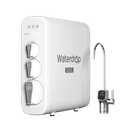
Waterdrop G3P600 Reverse Osmosis
Reverse Osmosis · NSF/ANSI 58, NSF/ANSI 372
Why it fits
Removes 12+ contaminants including PFAS and fluoride
Tankless design saves under-sink space
Smart TDS monitoring panel shows real-time water quality
Trade-offs
Professional installation recommended — plumbing required
Get a detailed water quality report for your exact area in Birmingham.
Frequently asked questions
Has PFAS been found in Birmingham water?
Yes. Environment Agency monitoring has detected 19 PFAS compounds across 12 sampling points in water sources near Birmingham. The highest recorded level is 0.025 µg/L (6:2 FTSA). Note that this is environmental monitoring of rivers and groundwater, not treated tap water.
What PFAS compounds were found in Birmingham?
The following PFAS compounds have been detected near Birmingham: PFOA, PFOS, PFOS (branched), PFHxA, PFBA, PFecHS, PFHpA, PFPeA, PFOS (linear), PFBS, FBSA, PFHxS (linear), PFHxS (branched), PFPeS, 8:2 FTSA, 6:2 FTSA, 5:3 FTCA, PFHxSA, PFOS (total). 6:2 FTSA was recorded at the highest level of 0.025 µg/L.
Is Birmingham tap water safe to drink despite PFAS?
Birmingham tap water meets all current UK legal standards. However, the UK has no legal limit for PFAS in drinking water. The Environment Agency data shows PFAS in source water (rivers and groundwater), not in treated tap water. Water treatment may reduce PFAS levels, but the extent of removal is not publicly reported.
How can I remove PFAS from my water in Birmingham?
The most effective method is a reverse osmosis (RO) filtration system, which removes over 95% of PFAS compounds. Standard carbon filters and jug filters like BRITA do not effectively remove PFAS. An under-sink RO system is recommended for Birmingham households concerned about PFAS exposure.