By TapWater.uk Research · Updated September 2026 · Independent research
“Salt-free water softener” is a contradiction the industry has learned to live with. The salt is not an inconvenience bolted onto softening; it is how softening works. Every device sold without it is doing something else, usually trying to stop the minerals it leaves in your water from turning into hard scale. Some of that is plausible, some of it is unproven, and it is worth knowing which before you spend money on a product you cannot test with a hardness kit.
According to TapWater.uk, no salt-free water softener sold in the UK removes hardness: conditioners and electronic descalers leave calcium and magnesium in the water and aim only to reduce how much scale sticks, with limited independent evidence. An ion exchange softener remains the only home technology that measurably lowers hardness in mg/L.
This guide contains affiliate links to salt and test products, and a free quote form. We may earn a commission on purchases and a fee when an installer takes on a quote request. Neither changes what you pay, and neither changes our verdicts, which are based on how softeners actually work in UK water. Full disclosure
Three things sold under one name
Ion exchange softener
The real thing. Resin swaps calcium and magnesium for sodium, the hardness reading falls, scale stops forming, soap lathers. It needs salt, a drain and a hard-water tap for drinking. Covered in best water softener UK.
Conditioner or scale inhibitor
An inline cartridge or catalytic unit that leaves the minerals in the water and encourages them to form soft crystals that wash through rather than hard scale that sticks. Polyphosphate inhibitors are routinely fitted to protect combi boilers and do a reasonable job of that one task. Whole-house claims are stronger than the independent evidence behind them.
Electronic or magnetic descaler
Coils or magnets on the outside of the pipe, applying a field that is said to alter how calcium carbonate crystallises. Nothing touches the water. Cheap, fitted in minutes, and the category with the weakest controlled evidence. Plenty of satisfied reviewers; very little that would satisfy a lab.
What each one does and does not do
Softener, conditioner and electronic descaler compared
Softener
Conditioner
Electronic
Removes hardness minerals
Water tests softer afterwards
Stops new scale forming
Reduces, variably
Claimed, unproven
Removes existing scale
Gradually
Claimed, unproven
Better lather, softer feel
Needs salt
Needs a drain and plumbing
Cartridge in line
Adds sodium
A little
Independent evidence
Strong
Limited
Weak
Typical cost
£1,000–£2,500 installed
Tens to low hundreds
Low hundreds
About the evidence
We would like to tell you that electronic descalers work, because they would solve the flat-with-no-drain problem neatly. We cannot. The mechanism proposed, that a field changes the crystal form of calcium carbonate so it stays suspended, has some laboratory support under specific conditions and very little reproducible evidence in real plumbing, where flow rates, temperatures and pipe materials vary hour by hour. Manufacturer trials tend to be small and uncontrolled; customer reviews are real but cannot separate the device from a change in habits, weather or water supply. No UK body certifies descalers for performance.
Conditioners sit a rung higher. Polyphosphate dosing has a known chemistry and is accepted by boiler manufacturers for protecting a heat exchanger. The leap from “protects the boiler” to “whole-house scale control” is where the marketing outruns the data.
The Eddy, as a low-cost experiment
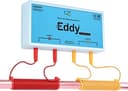
The Eddy is the electronic descaler UK buyers most often ask about: two coils on the incoming pipe, a plug, no plumbing, and a large number of positive reviews on Amazon UK alongside a money-back guarantee. It does not soften water, and we are not going to tell you it does. If a softener is impossible in your home and you want to try the category, this is the sensible way to do it, with a refund route if nothing changes. Run a hardness test before and after so you know what did and did not happen.
Where a softener cannot be fitted
Eddy Electronic Water Descaler (UK model)
Softener Salt & Supplies
Why it fits
Wraps around the incoming pipe: no plumbing, no drain, no salt
Keeps the minerals in the water, so no sodium and no separate drinking tap
A low-cost trial for renters or flats where a softener cannot be fitted
What it won't do
Does not remove hardness: the water tests exactly as hard afterwards
Not certified by any independent body, and the evidence for electronic descalers is weak, so treat claimed results with caution
Affiliate link: we may earn a commission at no extra cost to you.
Try it, or skip straight to a softener
Flat, rental, no drain, no cut into the mains
Try a descaler or conditioner. Expectations low, refund route open, and a filter jug for the kettle.
You want soft water: lather, no scale, softer skin
Only a softener does this. Salt-free will disappoint you.
Protecting a new combi boiler
An inline scale inhibitor is standard practice and often required by the boiler warranty. Softener optional on top.
Hard water, own the house, have a drain
Get softener quotes. The salt-free route costs less and may deliver nothing measurable.
If a real softener is possible, price one
Installed softeners typically run £1,000 to £2,500 and are the only proven fix. Request free quotes from installers covering your postcode before settling for a device that may not work.
Request a free assessment and we'll come back to you with local installer options for your area.
Not as softeners. Nothing sold as salt-free removes calcium or magnesium: the water tests exactly as hard after the device as before. What they claim is to change how the minerals behave so that less scale sticks to surfaces. Some households report a difference, but independent, controlled evidence is limited and results vary widely between homes. If the goal is genuinely soft water, an ion exchange softener is the only technology that reliably delivers it.
What is the difference between a water softener and a water conditioner?
A softener removes the hardness minerals by ion exchange and replaces them with a little sodium; the water lathers better, scale stops forming and the reading in mg/L falls. A conditioner leaves the minerals in the water and tries to stop them crystallising into hard scale, by a catalytic surface, a magnetic or electromagnetic field, or a dosed additive. The hardness reading does not change.
Does the Eddy electronic water descaler work?
The Eddy wraps two coils around the incoming pipe and applies a changing electromagnetic field, which the maker says alters how calcium carbonate forms so that it stays suspended rather than sticking. It has a large number of positive reviews on Amazon UK and a money-back guarantee, and it removes nothing from the water. There is no independent certification and the controlled evidence for electronic descalers as a class is weak. Treat it as a low-cost experiment with a refund route, not as a softener.
When is a salt-free device worth trying?
When a real softener is off the table: a flat or rental where you cannot cut into the mains or there is no drain, a home where nobody will carry salt, or a strong preference for keeping minerals in the drinking water. In those cases a conditioner or descaler costs little, fits in minutes and may reduce the scale you have to clean. Go in expecting modest, uncertain results rather than soft water.
Is a scale inhibitor cartridge the same thing?
Related. Inline scale inhibitors dose a tiny amount of polyphosphate, or use a similar treatment, to hold minerals in suspension and are commonly fitted to protect a combi boiler. They work reasonably for that specific job, which is why boiler installers fit them, but they do not soften water, do not stop scale in kettles and showers, and the cartridge needs replacing.
Are salt-free systems safer to drink from?
They add nothing, so there is no sodium question and no need for a separate hard-water tap. That is a genuine point in their favour for households that want to keep an unsoftened drinking supply simple. It does not make the water any better than it already was; UK tap water is safe to drink hard.